The data behind Iceland’s attack
Throughout the course of the Men’s EHF EURO 2026, data analyst Julian Rux will provide the handball community with deep insights into the numbers behind the game, analysing what the data says about teams’ and players’ performances. Next up is Iceland and their strong offence.

However, in tournaments not everyone plays against the same opponents and the differences in opponents’ quality can sometimes be huge. For example, teams that go far face much tougher opponents. To even out these problems the numbers can also be adjusted for opponent strength.
This adjustment is done by calculating how many goals scored and conceded per 50 possessions would be expected for each game and team by the number of goals the opponents scored and conceded per 50 possessions in their other games. So-called “garbage time”, when the game is already decided, is also filtered out. The differences to the actual goals scored and conceded can then be added to the goals scored or conceded per 50 possessions to have an adjusted rating.
In fact, looking at these ratings for offence Iceland ranks second with 32 opponent-adjusted goals per 50 possessions. The only team that is better is Denmark with 33.5. So, we can expect an offensive spectacle in the semi-finals.
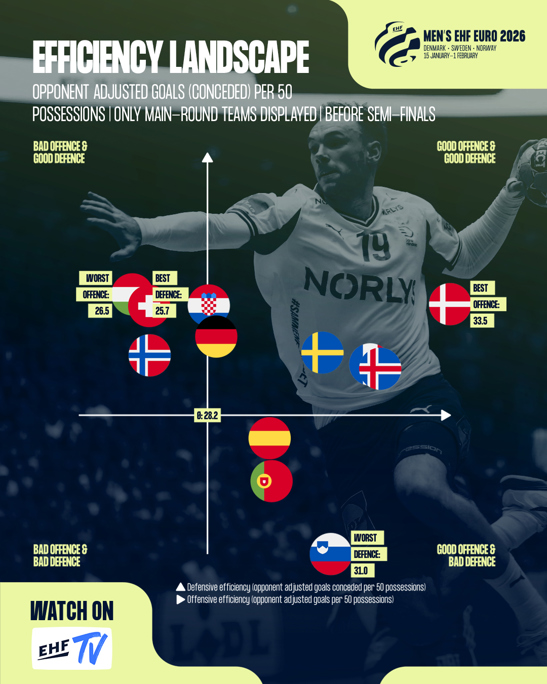
Defensively, Iceland rank 10th among all teams in the competition, with 27.2 opponent-adjusted goals conceded per 50 possessions. That is a bit better than average, as the chart above shows, but clearly worse than their semi-final opponents Denmark, who rank second with 25.9. So, the numbers emphasise that Iceland are the underdogs against the world and Olympic champions.
Based on even more detailed data are Expected Goals (xG) and metrics derived from it. In short, xG are the average value of a shot being scored based on thousands of shots on the past that is calculated by statistical models that are fed with several information of each shot such as the distance, angle, position of the goalkeeper or type of shot. Expected Goals were explained in detail in the first article of this series on EHF EURO 2026.
The average xG value per shows if a team makes high-quality shots. Iceland is here the best among the main round teams as well with 68.1 per cent. Overall, just the Faroe Islands were slightly better with 68.6 per cent, as their constant use of seven against six in positional attack led to many good scoring chances.
Here, Iceland’s back-court players stand out. Among all 51 back-court players with at least 25 non-penalty shots Janus Daði Smárason (74.1 per cent), Viggó Kristjánsson (68.0), Ómar Ingi Magnússon (65.5) and Gísli Kristjánsson (65.0) all rank in the top 13 in shot percentage. The only other team with more than one player in the top 13 is Denmark with Mathias Gidsel (73.0 per cent) and Simon Pytlick (72.9).
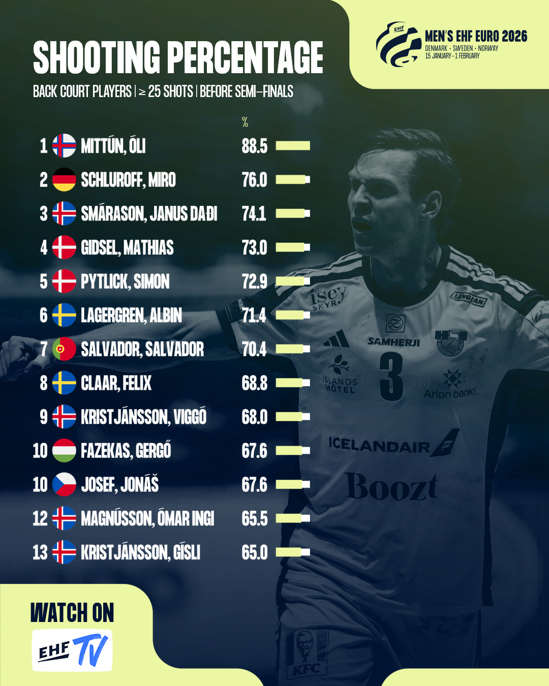
At the same time the four Icelandic players all also rank in the top 11 of the highest non-penalty shot quality among the 51 back-court players. So, their good shooting percentages are due to the fact that they regularly manage to get into very good scoring positions.
However, finishing ability or shot making, a second metric based on xG, show why it wasn't quite enough for the best offence in the competition. While all good teams clearly outperformed their xG, Iceland ranks just 11th overall and 10th among the 12 main round teams with 1.7 per cent more goals than expected. A small improvement here would make them the best offence in the tournament.